Here’s the next part to our introduction into sheet music. After learning about note identification, we’re going to get into the application of these notes. But to do that, you’ll have to understand the very beginning to every piece of sheet music ever written.
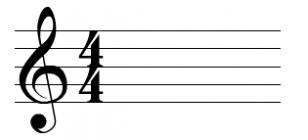
So you already know about the treble clef, key signature, and the notes on the staff. But there is something that brings it all together. Having a good sense of rhythm is important in music; but rhythm relies heavily on tempo. That’s where time signatures come in. A time signature will be represented by two number, one over the other. The top number represent how many beats in a measure and the bottom number signifies the note that gets the beat.
4/4 time signature is the most common time signature. Music is divided into measures, and each measure contains a certain amount of beats. In the case of 4/4 there will be four beats counted as 1, 2, 3, 4 over and over again. The bottom note in this example is a quarter note, but it can also an eighth note, a sixteenth note, and so on.
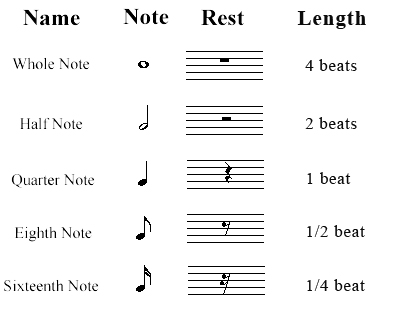
Now that we’re covering what time signature means, it’s also important to cover the lengths of notes and how they’re represented. Considering that we are in 4/4 time, a quarter note will only be 1 out of 4 beats. A half note is just 2 beats, and a whole note signifies all four beats. Notes can also be less than a quarter note. Rest are just place holders in which you don’t play. The following chart shows the different lengths of notes and rests.
Well, that’s it for now, I believe you are ready to read music without tabs. Use everything you’ve learned about reading to sheet music and chords and apply it to the following, good luck! But you may have noticed this it where it ends. That’s because I’m not going to make you read any piece of music. Try finding music that you like and read the music and chords. Have fun looking for music that inspires you to keep playing the guitar.
 Guitar: A Divergent Path