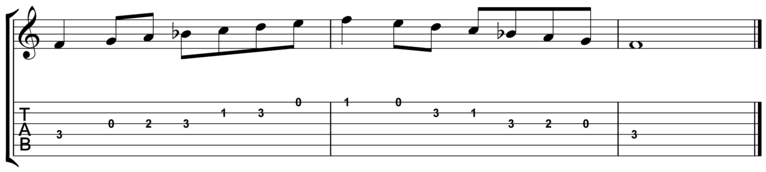
The major scale is one that you’ve probably heard of. It’s one of the most commonly used scales in western music. It’s a diatonic scale made up of seven notes. The sheet music below shows the F major scale ascending and descending.
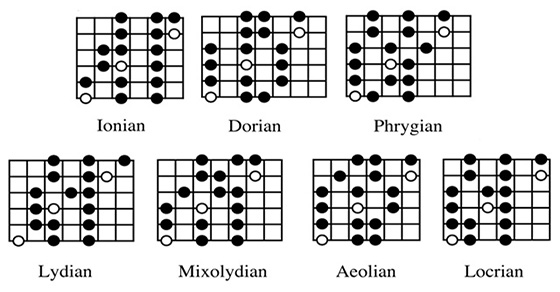
So we know what the Major Scale is, but what about modes? Well, to start off, they are used to access different tonalities. A mode is a scale, but starting on a different note of a certain scale, in this case, the major scale. Each position has its own name: Ionian (just a fancier way of saying the major scale), Dorian, Phrygian, Lydian, Mixolydian, Aeolian, and Locrian. One scale for every note in the major scale.
The diagrams down below may seem confusing, but it’s not that complicated once you understand it. It’s just like reading tabs, the sixth string is on the bottom and the high E string at the top. The horizontal lines represent the frets. In this case, there is no particular fret you must start on. If you want to play G Ionian, then you just find G on the low E string and play according to the diagram.The circles that are not filled in refer to the tonic, or root note. So if we start on G, we would get G Ionian, A Dorian, B Phrygian, C Lydian, D Mixolydian, E Aeolian, F# Locian, and back to G.
 Guitar: A Divergent Path