I believe reading sheet music is overlooked by many guitarists. Having this ability isn’t necessary, but it is a great skill to have. If you learn to read sheet music, you’ll have more confidence and a greater understanding of your fretboard. So today you’ll learn some common elements found in sheet music to and grow your musicianship overall.
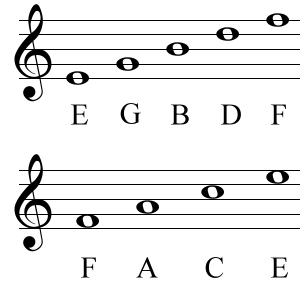
Standard notation is written on five horizontal lines. This is known as the staff, where every line and space represents a letter, which corresponds to a note. At the beginning of any piece of music you’ll see either a bass clef or a treble clef. Since you are playing guitar, make sure you read in treble clef. This means the lines represent E, G, B, D, F and the spaces refer to the notes F, A, C, E starting from the bottom of the staff. It’s important for you to understand that this is cycle that begins from A and ends at G, and then it repeats indefinitely.
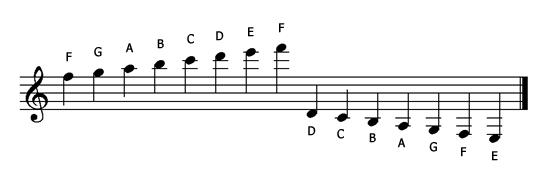
You will also see notes that extend above and below the staff, this is when ledger lines are used to allow more notes to be notated.
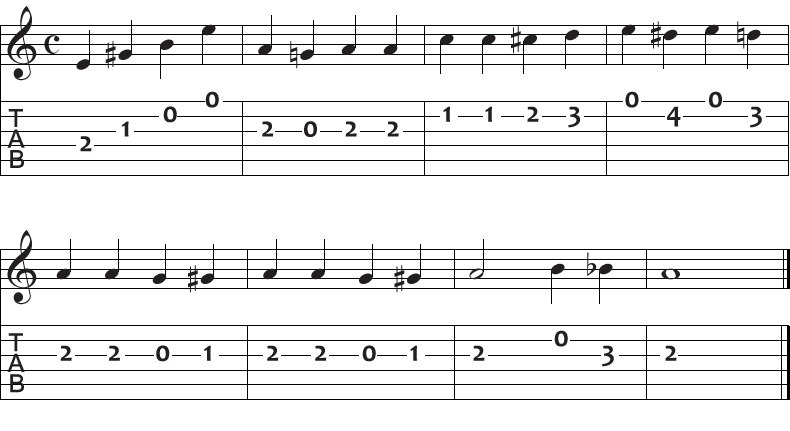
Accidentals are used quite often in notation, and will determine if a note is flat, natural, or sharp. If indicates that a note must be played a half step lower (flat), a half step higher (sharp), or back to the original note (natural) Here’s some practice to get you acquainted with accidentals.
In this lesson, we have discussed about the notes on the staff and understanding how they can be used. In the next part, we’ll dive deeper into sheet music and how to read your first song without the help of tabs.
 Guitar: A Divergent Path